Adding a battery backup to an existing sump can be a relatively straightforward add-on or a larger installation project. The cost depends mainly on the backup pump system, battery, charger, plumbing changes, and whether your current sump basin and discharge line can accept the second pump. Before buying, inspect the existing setup and compare the cost of a compatible backup system with the risk of basement flooding during a power outage.
Backup Systems · Mon Sep 07
Cost of adding a battery backup to an existing sump
Adding battery backup to an existing sump usually costs more than the backup pump alone. The final amount depends on whether you need only a pump and battery or also a new check valve, discharge plumbing, basin work, or professional electrical installation.
What do you need help with?
Open an answer, or tell us what we should cover next.
Answered in this guide
Estimate the cost of adding a battery backup
Break the project into backup equipment, battery, plumbing or basin work, electrical work, and labor. Add each part separately, because an existing sump may need more than just a backup pump and battery.
Understand what a battery-backup installation includes
The total project may include a backup pump, battery, controller, charger, alarm, check valve, discharge plumbing, basin work, and electrical installation, depending on the existing sump setup.
See what changes the backup installation price
Price changes with the type of backup system, battery capacity, the condition and layout of the sump, and any needed electrical or alarm wiring work.
Decide whether to install the backup yourself or hire a pro
A capable homeowner may handle a compatible installation when the basin, plumbing, and electrical supply are suitable. Professional help makes more sense for crowded basins, rerouted discharge pipes, or new electrical work.
Avoid unnecessary backup sump installation costs
Inspect the existing system before buying parts. Cleaning the basin, checking the primary float, and confirming that the discharge pipe is clear can prevent unnecessary replacements or added work.
Need something else?
Request a topic and help us choose what to build next.
Install a battery backup step by step
Fix a backup sump pump that will not start
Choose the right battery-backup sump systemRead this guide →
Requests help us prioritize the next guide. No email required.
One anonymous request per topic.
What the cost usually includes
A battery-backup installation may include several separate components:
- Backup pump: A dedicated pump operates when the primary pump loses power or cannot keep up with incoming water.
- Battery: Many systems use a deep-cycle battery rather than a standard automotive starting battery. Battery type and capacity affect both purchase cost and runtime.
- Charger or control unit: The charger keeps the battery ready and may provide alarms for power loss, low battery voltage, pump failure, or high water.
- Check valve: A separate check valve may be needed so water from one pump does not flow backward through the other pump.
- Discharge plumbing: The backup pump may connect to the existing discharge pipe, a separate outlet, or a manufacturer-specific fitting kit.
- Battery box or tray: A covered container helps protect the battery area from accidental contact and keeps the installation organized.
- Labor: Installation becomes more expensive when the basin is crowded, the discharge line must be modified, or electrical work is needed.
A system that fits beside the existing primary pump and connects to accessible plumbing will generally require less work than one that needs a new basin, major pipe rerouting, or a new exterior discharge route.
Battery backup pump system
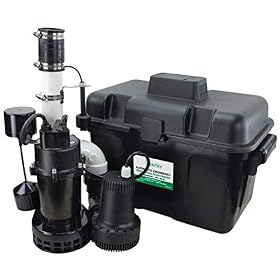 Basement Sentry Battery Backup Sump Pump System Combo (Pre-Assembled) Primary Sump Pump and Battery Back-up…Star
$365.00 as of
View on Amazon The Basement Watchdog Combo Preassembled Primary & Battery Backup Sump Pump System w/Monitoring Controller (CITS-50);…BASEMENT WATCHDOG
$469.00 as of
View on Amazon Basement Sentry Automatic Emergency Backup Sump Pump System (12V Battery Powered) Provides Additional Protection Against…Star
$165.00 as of
View on Amazon
Product prices and availability are accurate as of the date/time indicated and are subject to change. Any price and availability information displayed on Amazon.com at the time of purchase will apply to the purchase of this product.
The biggest factors that change the price
1. Pump-only backup versus a complete system
Some backup pumps are sold as part of a complete kit with a controller, charger, alarm, and installation fittings. Others require you to purchase the battery and some plumbing components separately.
Compare the complete parts list rather than the pump price alone. A lower-priced pump may become less economical if it needs a separate charger, battery box, check valve, or specialized fittings.
2. Battery type and capacity
The battery is a recurring cost because it eventually needs replacement. A deep-cycle marine-style battery is commonly specified for battery-backup sump systems, but the correct type depends on the backup system manufacturer. Some systems use sealed or maintenance-free batteries, while others use batteries that require periodic inspection and, where applicable, fluid maintenance.
Battery capacity affects runtime, but a larger battery is not automatically compatible with every charger. Follow the backup system's battery specifications, charging requirements, and ventilation guidance. Do not substitute a battery simply because its terminals fit.
3. Condition and layout of the existing sump
Installation is usually simpler when the existing basin is deep and wide enough for a second pump. A narrow or shallow basin may not leave sufficient room for both pumps, their switches, and the discharge connections.
The installer may also need to account for:
- A primary pump that is difficult to remove or reposition
- A discharge pipe with no convenient connection point
- A missing or incorrectly installed check valve
- Plumbing that discharges too close to the foundation
- A basin cover that does not accommodate the extra pipes or wiring
- Sediment or debris that interferes with the float switch
If the basin cannot safely hold both pumps, a separate backup basin or a different backup design may be necessary. That can change the project from a simple add-on to a more extensive plumbing job.
4. Electrical work and alarm wiring
A battery backup pump normally does not eliminate the need for a properly powered primary pump. The backup system is intended to operate during an outage, primary-pump failure, or unusually high water conditions, depending on its controls.
If the existing outlet is not properly grounded, is not protected as required by local code, or is exposed to moisture, have a qualified electrician evaluate it. Do not use an extension cord as a permanent solution, and do not modify electrical wiring unless you are qualified to do so.
Remote alarms, Wi-Fi modules, or connections to a home security system can add equipment and installation work. These features may be worthwhile if the sump is in a rarely visited area, but they are not required for every installation.
Replacement backup battery
 2500 Watt Sump Pump Backup Battery System, Automatic Switching to Battery Inverter Power, Professional Backup…VIOPUMPO
$319.99 as of
View on Amazon- Basement Sentry Automatic Emergency Backup Sump Pump System (12V Battery Powered) Provides Additional Protection Against…Star
$165.00 as of
View on Amazon  1500W Primary Sump Pump Backup System, Basment Protection Backup InverterMiumoon
$169.99 as of
View on Amazon
Product prices and availability are accurate as of the date/time indicated and are subject to change. Any price and availability information displayed on Amazon.com at the time of purchase will apply to the purchase of this product.
A practical way to estimate your project
Separate the estimate into four parts:
- Backup equipment: Pump, controller, charger, battery, and alarm features.
- Plumbing materials: Check valves, unions, fittings, discharge pipe, and supports.
- Installation labor: Mounting, plumbing, switch adjustment, testing, and cleanup.
- Electrical or structural changes: Outlet work, basin changes, battery ventilation, or a new discharge route.
Ask for an itemized quote. It should identify whether the battery is included, which check valves are being used, how the backup pump will discharge water, and whether the installer will test the system under simulated power-loss conditions.
Avoid comparing estimates based only on the pump's advertised gallons-per-minute rating. Actual performance depends on vertical lift, pipe diameter, fittings, check valves, and the discharge route. A pump that looks stronger on paper may not provide better results in your basement setup.
Backup discharge hardware
 Superior Pump 92900 12V Battery Back Up Submersible Sump Pump with Tethered SwitchSuperior Pump
$209.99 as of
View on Amazon
Product prices and availability are accurate as of the date/time indicated and are subject to change. Any price and availability information displayed on Amazon.com at the time of purchase will apply to the purchase of this product.
Can you add a battery backup yourself?
A capable homeowner may be able to install a compatible backup pump when the basin, plumbing, and electrical supply are already suitable. The work still requires careful attention to the manufacturer’s instructions and local plumbing and electrical requirements.
Before starting, confirm all of the following:
- The backup pump fits without restricting the primary pump or its float switch.
- The battery is the type and size specified by the manufacturer.
- The discharge connection prevents backflow between pumps.
- The check valves are oriented in the correct direction.
- The discharge pipe is supported and cannot pull on the pump.
- The battery area is protected from water and has the ventilation required by the battery type.
- The alarm and high-water sensor can be heard or monitored.
Unplug the primary pump and disconnect power before working around the basin. Never work on energized wiring in a wet area. If the installation requires new wiring, changes to a dedicated circuit, or uncertain code work, use a qualified electrician.
When professional installation is worth the added cost
Professional installation is especially reasonable when:
- The basin is crowded or too small for a second pump
- The discharge pipe must be cut or rerouted
- The system needs a new outlet or circuit
- The battery will be installed in a confined area
- The basement has previously flooded
- The primary pump installation is already unreliable
- You are unsure whether the existing check valve is working
A professional can also identify a more important problem: a backup pump does not correct an undersized primary pump, a blocked discharge line, a failed float switch, or water entering faster than the system can remove it.
Ways to avoid unnecessary expense
Start by inspecting the current system before buying parts. Clean sediment from the basin, verify that the primary float moves freely, and make sure the discharge pipe is not blocked or frozen. If the primary pump is old, noisy, or unreliable, replacing it at the same time may be more sensible than installing a backup beside a failing pump.
Choose a backup system that matches the actual vertical lift and pipe size. Also check whether the manufacturer requires a dedicated check valve or specific plumbing arrangement. Improvising fittings can create backflow, reduce pumping capacity, or prevent the float from operating correctly.
Finally, account for ongoing costs. Batteries have a finite service life, and the system should be inspected periodically for corrosion, alarm faults, loose connections, and reduced runtime. A backup that has never been maintained may not be ready when the power fails.
When replacing the whole sump setup makes more sense
Adding a battery backup is not always the best value. Consider replacing or redesigning the system when the existing basin is too small, the primary pump is near failure, the discharge plumbing is poorly routed, or the basement regularly receives more water than the current system can handle.
In those cases, a new primary pump, larger basin, improved discharge line, and backup system may provide more dependable protection than attaching another pump to an unsuitable installation.
FAQ
Is the battery included with a sump pump backup system?
Not always. Some systems include the controller, charger, and battery, while others require the battery to be purchased separately. Check the complete parts list and use only a battery type approved by the manufacturer.
Can a battery backup use the existing sump discharge pipe?
Often it can, but the connection must be designed to prevent backflow and avoid reducing either pump's performance. The correct check valve, pipe size, and connection method depend on the equipment and layout.
How long does a sump pump backup battery last?
Runtime depends on battery capacity, water inflow, pump demand, vertical lift, and how often the pump cycles. A backup may run much longer during light inflow than during a heavy storm. Follow the manufacturer's runtime guidance rather than relying on a single advertised figure.
Should I replace the primary sump pump when adding a battery backup?
Replace it if it is noisy, unreliable, corroded, frequently jams, or near the end of its service life. A backup system protects against some failures, but it does not make a failing primary pump dependable.