Best sump pump if you already have a battery backup on the shelf
If you already own a battery backup, the best primary sump pump is one sized for your pit and discharge height, with a setup your backup system can support. Here is how to choose without buying an incompatible pump.
If you already have a battery backup on the shelf, choose the primary sump pump around your pit, discharge height, and existing backup setup—not around horsepower alone. A reliable arrangement usually uses an AC-powered primary pump for normal operation and a separate battery-powered backup pump or backup controller for outages and primary-pump failure.
Before buying, determine whether your “battery backup” is a complete backup sump pump system or only a battery. A battery by itself cannot power a standard AC sump pump unless the manufacturer specifically provides a compatible inverter or control system.
Start by identifying the backup equipment
Look at the label and manual for the equipment you already own. Confirm whether it is:
A backup controller that operates a compatible pump
A battery only, such as a marine or deep-cycle battery
An inverter intended to power AC equipment
These are not interchangeable. A DC backup pump generally needs its specified battery type, charger, wiring, and controller. An inverter must be rated for the pump’s startup demand and used according to its instructions. If the equipment is unclear, identify the exact manufacturer and model before connecting a pump.
Never connect a pump to an unknown battery or improvised wiring. Incorrect voltage, polarity, fusing, or charging equipment can damage the pump or create a fire and shock hazard.
What makes a good primary sump pump for this setup?
Match output to the actual lift height
A pump’s advertised gallons-per-minute figure is usually measured under specific conditions. Real output decreases as the pump pushes water upward through the discharge pipe and fittings.
Measure the vertical distance from the pump’s position in the pit to the discharge outlet. Then account for horizontal pipe, elbows, check valves, and any other restrictions. Use the pump’s performance chart at that total head, rather than choosing solely by horsepower or a free-flow rating.
A pump that moves plenty of water at low lift may be a poor choice for a deep basement discharge. Conversely, an oversized pump can cycle more often if the pit is small or the inflow is modest.
Choose a pump that fits the basin and plumbing
Check these dimensions before purchasing:
Pump diameter and height
Minimum water level required for the float to switch on
The primary and backup pumps must be able to operate without their floats tangling or being trapped against the basin wall. If the backup pump is mounted above or beside the primary pump, leave enough clearance for both switches to move freely.
Prefer a dependable automatic switch
Most primary sump pumps use a tethered float, vertical float, diaphragm switch, or electronic sensor. The switch type affects how much room the pump needs and how frequently it cycles.
A tethered float often needs more open space in the basin. A vertical float can work better in a narrow pit but may have a shorter operating range. Electronic controls can have different maintenance and failure considerations. Use the manufacturer’s required installation orientation and avoid modifying the switch.
Product prices and availability are accurate as of the date/time indicated and are subject to change. Any price and availability information displayed on Amazon.com at the time of purchase will apply to the purchase of this product.
Check how the pumps share the discharge line
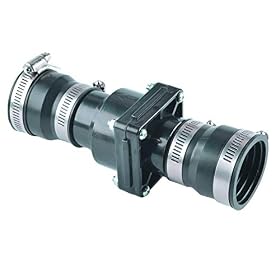
A common arrangement is for the primary and backup pumps to connect to a shared discharge line, with a check valve for each pump. This helps prevent discharged water from flowing backward through a stopped pump.
Follow the backup system’s piping instructions. Some systems specify separate check valves, a particular connection point, or a dedicated discharge route. Do not assume that adding a second pump to an existing pipe is acceptable without checking pipe capacity and the manufacturer’s diagram.
Use a check valve rated for sump-pump service and install it in the correct flow direction. An incorrectly installed or stuck valve can restrict flow, cause short cycling, or allow water to return to the basin after the pump stops.
Also confirm that the discharge line exits to a safe location away from the foundation. A backup pump is not useful if the shared line is frozen, blocked, or routed where water can return toward the house.
Product prices and availability are accurate as of the date/time indicated and are subject to change. Any price and availability information displayed on Amazon.com at the time of purchase will apply to the purchase of this product.
Battery compatibility matters more than battery size alone
If you have a complete backup system, use the battery type and capacity specified by that system. Some backup controllers require a specific voltage and may be designed for a deep-cycle battery rather than a starting battery. The charger must also be compatible with the battery chemistry.
A larger battery is not automatically a safe upgrade. It may charge incorrectly, fit poorly, or exceed the controller’s intended operating range. Follow the backup manufacturer’s requirements for:
Battery voltage
Battery chemistry
Minimum and maximum capacity
Charger type
Cable size and fuse protection
Ventilation and enclosure requirements
Keep batteries upright and protected from standing water. Lead-acid batteries can produce corrosive fumes and require appropriate ventilation. Wear eye protection when handling battery connections, and disconnect power according to the manufacturer’s procedure before servicing.
Product prices and availability are accurate as of the date/time indicated and are subject to change. Any price and availability information displayed on Amazon.com at the time of purchase will apply to the purchase of this product.
A practical selection process
Use this order when choosing the primary pump:
Measure the pit and discharge route. Record basin diameter, water depth, pipe size, vertical lift, and major fittings.
Read the backup system instructions. Look for requirements affecting shared piping, check valves, float placement, and battery operation.
Compare performance at working head. Select a pump that can handle expected inflow at your actual lift height.
Confirm physical clearance. Make sure both floats can move and neither pump blocks the other.
Check electrical requirements. Use a grounded, properly protected outlet suitable for the primary pump. Do not use an extension cord as a permanent installation.
Plan for service. Choose a design with accessible intake and removable components if the manufacturer supports that service.
Test the complete arrangement. Add water to the basin and verify the primary pump starts and stops normally. Then test the backup system using its manufacturer’s procedure, including any outage or alarm test.
For a permanently installed pump, have the electrical connection evaluated by a qualified professional when the outlet, grounding, GFCI protection, or wiring is questionable. Keep electrical connections above the highest expected water level.
Replacement battery for a compatible backup system
Product prices and availability are accurate as of the date/time indicated and are subject to change. Any price and availability information displayed on Amazon.com at the time of purchase will apply to the purchase of this product.
When the primary pump should be replaced instead of upgraded
Replacing only the pump is reasonable when the basin, discharge line, float arrangement, and backup system are in good condition. Consider replacing or reworking more of the system when:
The basin is too small for both pumps to operate safely
The discharge pipe is cracked, frozen, undersized, or poorly supported
The backup system has no compatible battery or charger available
The primary pump repeatedly trips a breaker or shows insulation, wiring, or motor damage
Water returns to the pit because check valves are missing or failing
The existing system cannot keep up with inflow even when operating correctly
If a pump trips a breaker, smells burnt, has damaged wiring, or energizes unexpectedly, disconnect it safely and stop troubleshooting live electrical parts. A qualified electrician or sump-pump installer should inspect it.
Bottom line
The best sump pump for your situation is a correctly sized primary AC pump that fits beside the backup, matches the discharge system, and leaves the battery equipment operating within its specified limits. Identify the backup equipment first, compare pump performance at the actual lift height, and test both pumps after installation. A battery on the shelf is useful only when the pump, controller, charger, and battery are a compatible system.
FAQ
Can I use a regular AC sump pump with a battery backup?
Usually, the AC pump serves as the primary pump and the battery backup operates a separate DC pump or compatible backup system. A battery alone cannot normally power a standard AC sump pump without a properly rated, manufacturer-approved inverter and control arrangement.
Should the primary sump pump be larger than the backup pump?
Not necessarily. Size each pump for the expected inflow and the actual vertical lift and piping restrictions. The primary pump may have greater capacity for normal operation, but the backup must still be capable of limiting water rise during an outage or primary-pump failure.
Do both sump pumps need check valves?
Many shared-discharge installations use a check valve for each pump, but the correct arrangement depends on the backup system and piping design. Follow the manufacturer’s diagram and verify each valve’s flow direction.
Can I use any battery with a battery backup sump pump?
No. Use the voltage, battery chemistry, capacity range, charger, and wiring specified by the backup manufacturer. An incompatible battery can charge improperly, damage the controller, or create a safety hazard.