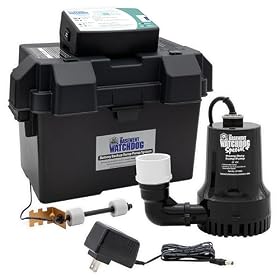
Buying a spare primary pump before hurricane season
A spare sump pump can prevent a flooded basement when the primary pump fails during a storm. Before buying, match the pump to your basin, discharge pipe, electrical supply, switch style, and required pumping performance.
What do you need help with?
Open an answer, or tell us what we should cover next.
Answered in this guide
Choose a spare primary sump pump that matches your existing setup
Use the pump already installed as your reference, then match the spare to the basin, discharge plumbing, switch movement, electrical supply, and required pumping performance so it can replace the primary pump when needed.
Match the pump’s capacity to your discharge plumbing
Compare the pump’s actual performance at the required lift and discharge distance, including pipe runs, elbows, and the check valve, rather than relying only on the horsepower printed on the label.
Check that the spare pump fits the discharge connection
Confirm the pump outlet, existing discharge pipe, adapters, and check valve are compatible before buying, so the replacement does not require unsafe or improvised plumbing changes.
Choose between a replacement pump and a ready-to-install kit
Buy only the pump when the existing fittings and switch arrangement already work; choose a replacement-ready kit when the included components make a fast, compatible swap easier.
Keep the spare indoors with its fittings protected, then compare it with the working system and perform basic readiness checks before storms arrive so it can be used quickly.
Requests help us prioritize the next guide. No email required.
One anonymous request per topic.
A spare primary sump pump is worthwhile before hurricane season if your basement depends on one pump for flood protection. The safest purchase is not necessarily the pump with the highest horsepower; it is a compatible replacement that fits your basin, connects to your discharge plumbing, handles the expected water flow, and can be installed quickly.
Start with the pump you already have
Before shopping, photograph the existing pump, label, discharge connection, plug, and float switch. Record:
Pump brand and model, if listed
Horsepower and voltage
Discharge pipe diameter
Whether the pump uses a tethered float, vertical float, electronic sensor, or separate switch
Whether it plugs into a standard grounded household outlet
The approximate height and distance the discharge line must move water
The basin’s inside diameter and usable depth
Keep the old pump in place while comparing replacements. A spare that cannot fit through the basin opening or connect to the existing discharge line is not a useful emergency replacement.
Match the pump’s capacity to the plumbing
Sump pump capacity depends on more than the horsepower printed on the label. A pump must move water upward through the vertical lift and then through the horizontal discharge run, elbows, check valve, and outlet. More restrictions and greater lift reduce the actual flow.
When comparing pumps, look for a performance chart that shows flow at different head heights. Use the height from the pump’s water outlet to the discharge point, not simply the basement ceiling height. If the discharge line exits through a wall and runs a long distance outdoors, account for that run and its fittings as well.
Avoid choosing solely by horsepower. Two pumps with similar horsepower can have different flow characteristics, outlet sizes, switch designs, and electrical requirements. A replacement should meet or exceed the existing pump’s practical capacity without exceeding the circuit or manufacturer-approved setup.
If you are uncertain about the required capacity, compare the current pump’s performance information with the replacement manufacturer’s chart. For a basement that has flooded before, a plumber or qualified installer can help determine whether the existing system is undersized.
Product prices and availability are accurate as of the date/time indicated and are subject to change. Any price and availability information displayed on Amazon.com at the time of purchase will apply to the purchase of this product.
Check discharge pipe and check-valve compatibility
Most replacement decisions become easier once the discharge connection is identified. Confirm:
The pump outlet size
The existing discharge pipe size
Whether an adapter is included or required
The check valve’s size and direction of flow
Whether there is enough straight pipe to make a secure connection
A check valve prevents water in the discharge pipe from draining back into the basin after the pump stops. If the spare pump has a different outlet size, you may need a correctly sized adapter or a replacement check valve. Do not force mismatched fittings together or rely on a loose friction fit.
The check valve arrow should point away from the pump. A reversed or leaking valve can cause short cycling, extra run time, and reduced effective pumping capacity.
Product prices and availability are accurate as of the date/time indicated and are subject to change. Any price and availability information displayed on Amazon.com at the time of purchase will apply to the purchase of this product.
Confirm the float switch will work in the basin
The switch is just as important as the motor. A tethered float needs room to move without catching on the pump, basin wall, discharge pipe, or other equipment. A vertical float needs sufficient water depth and clearance to turn the pump on and off.
Before buying, measure the basin’s inside diameter and inspect the space around the existing pump. If the basin is narrow, a compact pump or a switch designed for confined spaces may be more suitable than a larger pump with a wide float movement.
Do not install a switch where it can be trapped underneath the pump or wedged against the plumbing. A trapped switch may leave the pump running continuously or prevent it from starting.
Verify voltage, plug, and circuit requirements
Use a pump with electrical requirements that match the home’s supply and the manufacturer’s instructions. Many residential sump pumps use standard household power, but the exact voltage, amperage, plug, and circuit requirements vary.
The outlet should be properly grounded and protected as required by local code and the pump instructions. Keep electrical connections dry, and do not use an extension cord as a permanent sump pump installation. If the outlet, wiring, breaker, or grounding is questionable, have a qualified electrician inspect it.
A spare pump is not useful if it requires a circuit that is already overloaded or if its plug and cord cannot be safely positioned above possible floodwater.
Decide whether to buy only a pump or a replacement-ready kit
Buying only the pump can make sense when the existing discharge plumbing, check valve, switch arrangement, and fittings are in good condition. It is usually the least disruptive option if you are preparing a direct replacement.
A discharge kit or additional fittings may be worthwhile when:
The existing pipe is brittle, cracked, or poorly supported
The check valve leaks or is difficult to access
The replacement pump has a different outlet size
You want to preassemble a replacement section
The current plumbing has multiple restrictive elbows
Do not replace sound plumbing unnecessarily, but do not assume old PVC, rubber couplings, or clamps will remain reliable during an emergency. Inspect them before storm season rather than discovering a leak while changing the pump.
Consider a second pump or backup system separately
A spare primary pump is a replacement for a failed pump. It does not provide the same protection as a second pump that can operate while the primary pump is still installed.
If your basin and electrical setup allow it, a separate backup pump can provide additional protection during a primary pump failure or unusually high inflow. Battery-powered and water-powered backup systems have different installation requirements and limitations. A battery backup also depends on battery condition, charger operation, and the expected outage duration.
For a home at high flood risk, consider the entire system: primary pump, backup pump, check valves, discharge routing, power source, and alarms. Follow the manufacturer’s installation instructions and local requirements.
Store the spare so it can be used quickly
A spare pump should be ready to install, not buried in an unopened box after the storm begins. Store it indoors in a dry location with:
The pump and switch protected from damage
The correct fittings, clamps, adapters, and check valve if needed
Installation instructions
A compatible screwdriver or wrench
A flashlight and work gloves
The pump’s model and electrical information recorded nearby
Do not store the pump with the motor submerged or allow dirt and debris into its intake. Keep batteries for alarms or backup systems maintained according to their instructions.
If practical, identify how the pump will be connected before an emergency. A professional can install a union or other serviceable connection that makes future replacement easier, provided the fitting is suitable for the system.
Perform a dry-season readiness check
Before hurricane season, inspect the working system and confirm that the spare matches it. You can perform basic checks without special tools:
Unplug the pump before touching it or the plumbing.
Check the discharge pipe, couplings, and check valve for cracks or leaks.
Remove debris from the basin while following the pump instructions.
Confirm the float moves freely through its full range.
Plug the pump back in only when all connections are dry and safe.
Add water gradually if the manufacturer permits a functional test, and verify that the pump starts, moves water outside, and shuts off normally.
Make sure discharged water flows away from the foundation and does not return to the basin.
Never run a pump dry unless the manufacturer specifically allows it. Keep hands, tools, and loose clothing away from moving parts, and disconnect power before servicing.
When a different pump or professional installation is the better choice
Choose a different replacement if the pump cannot fit the basin, its switch cannot move freely, its discharge connection requires unsafe improvisation, or its performance chart does not meet the system’s lift and flow needs.
Professional help is appropriate when the basin fills rapidly, the discharge line is buried or inaccessible, the electrical supply is questionable, the home has experienced repeated pump failures, or the pump cannot keep up even when operating correctly. Repeated failures may indicate a bad switch, blocked discharge line, undersized plumbing, excessive inflow, or a power problem rather than a need for another identical pump.
A spare primary pump is a sensible seasonal precaution, but compatibility matters more than a large horsepower label. Match the replacement to the existing system, prepare the required fittings in advance, and verify that the pump can safely move water through the full discharge route.
FAQ
Should a spare sump pump be the same brand as the existing pump?
Not necessarily. It should match the required voltage, discharge connection, basin clearance, switch arrangement, and pumping performance. A different brand can work if it is compatible with the complete installation.
Is a higher-horsepower sump pump always better?
No. Horsepower alone does not determine useful performance. Compare flow at the system’s required lift and account for pipe size, elbows, check valves, and discharge distance. A larger pump may also need more electrical capacity or may cycle poorly in a small basin.
Can I leave a spare sump pump connected beside the primary pump?
Only if the basin, switches, plumbing, and electrical circuit are designed for that arrangement. A second pump may be a backup system, but it should not interfere with the primary pump or create an overload. Follow the manufacturer’s instructions or have the setup installed professionally.
What should I do if the spare pump does not start during a storm?
Disconnect power before inspecting it. Check for a tripped breaker or GFCI, a blocked intake, a stuck float, a disconnected plug, or a closed or obstructed discharge path. Keep clear of standing water around electrical equipment and contact a qualified professional if the electrical cause is not obvious.