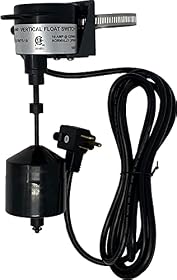
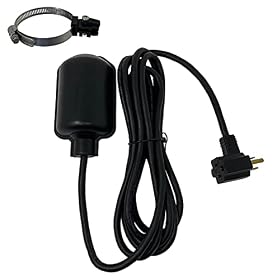
Vertical floats are compact and work well in narrow sump basins, while tethered floats need more room but can provide a longer pump cycle. Choose based on basin space, pump capacity, and how often the pump cycles.
What do you need help with?
Open an answer, or tell us what we should cover next.
Answered in this guide
Choose between a vertical and tethered sump pump float
Choose a vertical float for a narrow or crowded basin. Choose a tethered float when the basin has enough room for the float to swing and you want a longer operating range between starts and stops.
Understand how vertical and tethered floats operate
Both float types start the sump pump as water rises and stop it after the water level drops. A vertical float moves mainly up and down, while a tethered float swings through a wider arc.
Short cycling means the pump starts and stops repeatedly over a small water-level change. A float with a suitable operating range, installed with enough movement room, can reduce unnecessary starts and related pump wear.
Diagnose a sump pump float that is not working properly
Check power, make sure the float is not trapped, and look for movement or installation problems. These checks help identify why the pump will not start, runs continuously, starts too often, or has a sticking float.
Check float switch compatibility before changing it
Before replacing or changing a float, confirm that the switch is approved for the pump’s electrical load and design. Also check that the float has enough room to move and is suitable for the basin and pump setup.
Request a topic and help us choose what to build next.
Install or replace a sump pump float switch
Size a sump pump for basement water flow
Choose a solid-state or mechanical sump pump switch
Requests help us prioritize the next guide. No email required.
One anonymous request per topic.
A vertical float is usually the better choice for a narrow sump basin or a pump that must start and stop within a limited water-level range. A tethered float needs more room to swing, but it can allow a longer pump cycle and may reduce frequent starts in a larger basin. The right option depends mainly on basin diameter, pump design, water inflow, and the manufacturer’s approved switch arrangement.
How the two float types work
Both floats turn the sump pump on as the water rises and turn it off after the water drops. The difference is how the float moves.
Vertical float
A vertical float travels up and down on a fixed rod or guide. As the water rises, the float moves upward and activates the switch. As the water level falls, it moves down and shuts the pump off.
A vertical float typically has a compact operating path. That makes it useful when the sump basin is narrow, the pump is close to the basin wall, or other equipment leaves little room for a swinging float.
Tethered float
A tethered float is attached to the pump or switch by a flexible cord. Instead of moving only vertically, it swings outward as the water rises. The swing activates the pump, and the float returns toward the pump as the water level falls.
Because the float travels through an arc, a tethered design usually needs more clearance inside the basin. Its larger operating range can also let the pump run longer before shutting off.
Vertical float versus tethered float at a glance
Consideration
Vertical float
Tethered float
Space required
Lower; moves mostly up and down
Higher; needs room to swing
Best basin type
Narrow or crowded basins
Wider, unobstructed basins
Water-level range
Usually more limited
Usually broader and adjustable by tether length or placement
Installation concern
Float must slide freely on its guide
Float must not snag, rest against the wall, or contact the pump cord
Cycling behavior
May start and stop more often in a high-inflow system
Can allow a longer run cycle when properly positioned
Main risk
Sticking from debris or restricted movement
Tether snagging or insufficient clearance
These are general design differences. Exact activation levels, switch limitations, and installation requirements vary by pump and switch model.
Product prices and availability are accurate as of the date/time indicated and are subject to change. Any price and availability information displayed on Amazon.com at the time of purchase will apply to the purchase of this product.
Choose a vertical float when space is limited
A vertical float is generally the safer fit when:
The basin is narrow.
The pump sits close to the basin wall.
A lid, discharge pipe, backup pump, or liner limits the float’s movement.
You want a compact switch arrangement.
The pump manufacturer specifies a vertical-float configuration.
Before choosing one, check that the float can move through its full travel without touching the basin, pump, discharge pipe, power cord, or other equipment. A float that rubs or catches can leave the pump running continuously—or prevent it from starting.
Product prices and availability are accurate as of the date/time indicated and are subject to change. Any price and availability information displayed on Amazon.com at the time of purchase will apply to the purchase of this product.
Choose a tethered float when the basin has room
A tethered float may be a better match when:
The basin is wide enough for unobstructed float movement.
The pump receives substantial inflow and benefits from a longer run cycle.
You need a larger difference between the pump-on and pump-off water levels.
The manufacturer approves the tethered switch for that pump.
Do not assume that a large basin automatically makes a tethered float suitable. The float still needs clearance from the pump, basin walls, discharge piping, cords, and any backup equipment. The tether should not be lengthened or repositioned beyond the manufacturer’s instructions.
Product prices and availability are accurate as of the date/time indicated and are subject to change. Any price and availability information displayed on Amazon.com at the time of purchase will apply to the purchase of this product.
Which float reduces short cycling?
Short cycling occurs when the pump starts and stops repeatedly during a relatively small change in water level. Frequent starts can increase wear and may indicate that the float’s operating range is too narrow for the water entering the basin.
A tethered float often provides a wider operating range, which can allow the pump to run longer per cycle. However, it does not automatically solve short cycling. The problem may instead come from:
A weak or intermittent water inflow.
A float that is catching on the basin or pump.
A check valve that allows discharge water to drain back into the basin.
A discharge pipe that is restricted.
A pump that is too large or too small for the application.
Incorrect float placement or adjustment.
A vertical float can work properly in a high-inflow system if its operating range and pump capacity are appropriate. Compare the pump’s specified cycle requirements rather than choosing only by float style.
Reliability and common failure points
Neither design is automatically maintenance-free. The most common practical problems are related to movement and installation.
Vertical-float problems
Debris prevents the float from sliding freely.
The guide or rod becomes misaligned.
The float contacts the basin wall.
The pump shifts and changes the float’s clearance.
A clean, unobstructed installation matters more than the float style alone. During routine maintenance, unplug the pump before touching it, then manually move the float through its full operating path. It should move freely without rubbing, snagging, or requiring force.
Installation and compatibility checks
Before replacing or changing a float, verify the following:
Pump compatibility: Use only a switch approved for the pump’s electrical load and design. A separate float switch may not be suitable for every sump pump.
Basin clearance: Measure the available space, including room for the float’s full travel—not just the pump’s footprint.
Cord routing: Keep the power cord and float cord away from the float’s path. Do not create loops that can catch the float.
Discharge and check valve clearance: Make sure piping and fittings do not obstruct the float.
Pump movement: Secure the pump as directed so vibration or discharge thrust cannot move it into the float.
Lid compatibility: A sealed or fitted basin lid may need a specific float arrangement. Do not cut or modify a lid unless the manufacturer permits it.
Manual test: After installation, add water gradually and confirm that the pump starts and stops at the intended levels.
Disconnect electrical power before repositioning a pump, float, cord, or discharge component. Keep electrical connections dry, and follow the pump and switch instructions. If the wiring, circuit protection, or pump load is unclear, use a qualified electrician.
Troubleshooting a float that does not work correctly
The pump does not start
Confirm the pump is receiving power.
Check that the float is not trapped in the off position.
Remove debris around the float’s guide or swing path.
Confirm the basin water level is high enough to activate the switch.
Check the float cord and plug for damage.
If the float moves freely but the pump does not run, the switch, pump, or electrical supply may have failed.
The pump runs continuously
Lift and lower the float by hand, if the design allows it, while keeping clear of electrical connections.
Look for a tether or vertical float touching the basin, pump, or pipe.
Check whether the pump can lower the water level below the switch-off point.
Inspect the discharge line for blockage or a closed valve.
Check the check valve for incorrect installation or excessive backflow.
If the water level falls but the pump continues running, stop using it and inspect the switch or have it serviced.
The pump starts too often
Check for water flowing back through the discharge line.
Confirm the float has enough operating range.
Look for a partially blocked discharge pipe.
Make sure the pump is not moving and changing the float position.
Consider whether the pump’s capacity and float arrangement match the inflow rate.
The float sticks after cleaning
A float that still sticks after debris is removed may have a damaged guide, worn hinge, waterlogged float, damaged cord, or failing switch. Replace the compatible float or switch assembly if the manufacturer offers one. If the replacement cost, compatibility, or wiring is uncertain—or if the pump is old and unreliable—a complete replacement pump may be the more dependable option.
Which one should you buy?
Choose a vertical float when compact movement and basin clearance are the priorities. Choose a tethered float when you have a wide, unobstructed basin and need a broader water-level range or longer pump cycles.
Do not replace one style with the other based only on appearance. Match the replacement to the pump’s rated load, basin dimensions, required activation levels, cord arrangement, and manufacturer instructions. If the basin is crowded, a vertical design is usually easier to keep clear. If the basin is spacious but the pump short-cycles, a properly installed tethered design may be worth considering.
FAQ
Is a vertical float better than a tethered float?
Neither is universally better. A vertical float is usually better for narrow or crowded basins, while a tethered float can be useful in a wider basin where a longer operating range is desirable.
Can I replace a vertical float with a tethered float?
Only if the replacement switch is electrically compatible with the pump and has enough room to swing freely. Follow the pump and switch manufacturer’s instructions rather than assuming the designs are interchangeable.
How much space does a tethered sump pump float need?
It needs enough unobstructed room for the float to swing through its full operating arc without contacting the basin, pump, cords, piping, lid, or backup equipment. The exact clearance depends on the switch design.
Why does my sump pump float get stuck?
Common causes include debris, contact with the basin wall, a trapped cord, a tether caught on piping, pump movement, or a damaged float mechanism. Disconnect power before inspecting or repositioning the assembly.
Does a tethered float prevent short cycling?
It may reduce short cycling by providing a wider operating range, but it cannot correct every cause. Check the check valve, discharge line, float clearance, pump sizing, and water inflow as well.