The head-height number tells you how much vertical lift a sump pump can overcome, but it does not tell the whole story. A pump advertised with a high gallons-per-hour rating may move far less water once it pushes water uphill through a long discharge pipe, elbows, and a check valve. For a useful comparison, look for the pump curve or flow ratings at specific head heights—not just the free-flow number.
Size & Head · Mon Sep 07
Head-height numbers reviewers skip
A sump pump’s maximum gallons-per-hour number is only part of the story. Head height, shutoff head, pipe friction, check valves, and discharge layout determine how much water the pump can actually move.
What sump pump head height means
Head height is the vertical lift a pump must overcome while moving water from the sump to the discharge point. It is usually expressed in feet.
A pump’s listed gallons-per-hour or gallons-per-minute figure is often measured at little or no lift. That condition is sometimes called zero-head or free-flow performance. It can be useful for comparing pumps generally, but it does not represent a typical basement installation.
The pump must also overcome resistance from:
- Vertical pipe or hose
- Horizontal discharge runs
- Elbows and fittings
- A check valve
- Narrow or corrugated discharge hose
- Restrictions at the outlet
The combined effect is often called total dynamic head. Manufacturer specifications do not always present this information in exactly the same way, so check the manual or performance chart before comparing numbers.
Replacement backflow protection
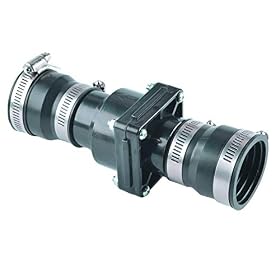 Hydro Master Plastic Sump Pump Check Valve with Stainless Steel Clamps for 1-1/2 inch or…HYDRO MASTER
$15.99 as of
View on Amazon Little Giant CV-10 Check Valve for the following Little Giant Series Condensate Pumps - VCC,…Little Giant
$8.27 as of
View on Amazon Threlaco 2 Pack Sump Pump Check Valve Fit 1-1/2 inch and 1-1/4 inch PipeThrelaco
$22.99 as of
View on Amazon
Product prices and availability are accurate as of the date/time indicated and are subject to change. Any price and availability information displayed on Amazon.com at the time of purchase will apply to the purchase of this product.
The head numbers that matter
Rated flow at operating head
This is the most useful number for sizing. It tells you how much water the pump can move at a particular lift, such as the height required by your discharge route.
If a specification lists several flow rates at different head heights, use the value closest to your actual installation. A pump that moves a large volume at zero head may be a poor choice if it produces weak flow at your required lift.
Maximum or shutoff head
Maximum head, also called shutoff head, is the approximate height at which the pump can no longer produce useful flow. It is not a recommended operating height.
A pump operating near its shutoff head may discharge only a small amount of water. It can also take longer to lower the basin during heavy inflow. As a practical buying rule, your calculated operating head should leave a meaningful margin below the pump’s maximum head.
Do not treat a pump’s maximum head as the height at which it will deliver its advertised gallons-per-minute rating.
Flow curve
A flow curve shows how output decreases as head increases. It is usually more informative than a single maximum-flow number.
When reviewing a curve, find the point where your installation’s head intersects the pump’s output. If the manufacturer provides no curve or head-specific flow figures, comparisons are less certain. Consider contacting the manufacturer rather than assuming the free-flow rating applies to your system.
Discharge routing components
 Superior Pump 99621 Lay-Flat Discharge Hose Kit, 1-1/2-Inch by 25-Foot PVC Hose, with AdaptersSuperior Pump
$27.99 as of
View on Amazon Hicarer Dual Pump Install Kit, Y-Connector with Screwdriver, Basement Water Pump Backup, Submersible Double Sump…Hicarer
$43.99 as of
View on Amazon Red Lion RL-SPDK Sump Pump Discharge Hose Kit, Fits 1-1/4" and 1-1/2" FNPT Discharge, 24-Feet…Red Lion
$33.17 as of
View on Amazon
Product prices and availability are accurate as of the date/time indicated and are subject to change. Any price and availability information displayed on Amazon.com at the time of purchase will apply to the purchase of this product.
How to estimate your installation’s head
Use a conservative estimate before choosing a replacement pump:
- Measure the vertical rise from the pump’s discharge area to the point where water exits the building or connects to the approved drainage system.
- Account for the normal discharge route, including horizontal pipe runs and fittings.
- Check the manufacturer’s guidance for converting pipe friction and fittings into additional head.
- Include the check valve and any outlet restriction.
- Compare the resulting estimate with the pump’s head-specific flow rating.
The exact starting point for the measurement can vary by manufacturer. Some specifications refer to the pump discharge, while installation calculations may also consider the water level and system layout. Follow the pump manual’s definition when available.
Measure the route as it exists—not as a straight line from the pit to the outside wall. A long horizontal run does not add the same vertical lift as a vertical rise, but it still creates friction and reduces flow.
Why reviewers often skip these numbers
Product listings tend to highlight simple specifications that are easy to compare, such as maximum gallons per hour, motor horsepower, or maximum head. Those figures can be misleading when shown without test conditions.
A more useful review or buying comparison should answer these questions:
- At what head height was the flow measured?
- Is the listed flow a free-flow figure?
- Is there a performance curve?
- What discharge-pipe size does the manufacturer assume?
- Does the stated maximum head mean complete shutoff or a minimum flow threshold?
- Is the pump designed for a check valve in the discharge line?
- Does the pump maintain adequate flow at the height of the actual outlet?
If those details are missing, treat the flow number as a rough reference rather than a prediction of basement performance.
Check valve and pipe size can change the result
A check valve helps prevent water in the discharge pipe from flowing back into the basin after the pump stops. That can reduce cycling and keep the pump from lifting the same water repeatedly. However, the valve also adds resistance, and a poorly matched or partially obstructed valve can restrict flow.
Pipe size matters as well. A smaller line generally creates more resistance than a properly sized larger line, especially over long runs. Corrugated discharge hose may be convenient, but its internal ridges can create more resistance than a smooth-walled pipe.
Use the pipe diameter specified by the pump manufacturer whenever possible. Do not reduce the outlet size simply to match an existing fitting without checking the installation requirements.
Head height versus switch and basin details
Head height is not the only sizing issue. The pump must also fit the basin and operate correctly with the float or switch arrangement.
Check the following before buying:
- The pump’s physical dimensions and required basin diameter
- The switch’s required movement or clearance
- The pump’s discharge connection size
- Whether the pump is intended for continuous or intermittent sump service
- Whether the pump handles the type of water and debris expected in the basin
- Whether the electrical connection and circuit meet the manufacturer’s requirements
A pump with adequate head capacity can still perform poorly if the float is trapped, the basin is too small, or the discharge connection is improperly adapted.
A practical way to compare two pumps
Suppose two pumps have similar free-flow ratings. Do not choose between them using that number alone. Instead:
- Estimate your actual vertical lift.
- Add the likely resistance from the pipe layout, fittings, and check valve.
- Find each pump’s flow at that operating head.
- Prefer the pump that provides useful flow with some capacity remaining above your estimated head.
- Confirm that the pump fits the basin and matches the required discharge and electrical setup.
If the manufacturer gives only maximum flow and maximum head, the comparison is incomplete. A pump with a published curve or several head-specific flow points is easier to size responsibly.
When the head estimate does not match real performance
If a sump pump runs but removes water slowly, check the simple physical causes first:
- Clean or replace a clogged intake screen or filter, if the pump has one.
- Inspect the discharge pipe or hose for ice, mud, debris, kinks, or a crushed section.
- Check the check valve for a stuck flap, incorrect installation, or debris.
- Look for leaking joints that return water to the pit or spray inside the basin.
- Confirm that the pipe follows the intended route and has not been reduced to a smaller size.
- Make sure the float or switch can move freely and that the pump is not sitting on debris.
- Check whether the basin is filling faster than the pump can handle.
- Recalculate the vertical rise and compare it with the pump’s head-specific performance.
Unplug the pump before handling it, and keep electrical connections dry. Do not bypass safety switches or modify wiring unless the manufacturer specifically permits the work and you are qualified to perform it.
A replacement check valve, discharge component, or pump may be reasonable when the existing part is cracked, obstructed, worn, or no longer compatible with the system. Replace the pump when it cannot deliver adequate flow at the required head, repeatedly overheats or trips protection, makes unusual mechanical noises, or shows signs of electrical damage. Follow the manufacturer’s installation instructions, and use a qualified professional for uncertain electrical work or major discharge changes.
The specification to prioritize
For a sump pump, the most useful performance specification is flow at your actual operating head. Maximum gallons per hour helps establish a general comparison, while maximum head indicates the upper limit. Neither replaces a performance curve or head-specific flow rating.
Before choosing a pump, measure the discharge route, account for friction and the check valve, and select a unit that still provides useful flow below its shutoff head. That approach gives you a more realistic comparison than relying on the biggest number in a product listing.
FAQ
What is a good head height for a sump pump?
There is no single ideal head height. The pump should have a published flow rate at or above the vertical lift and pipe resistance in your installation, with margin below its maximum or shutoff head.
Is maximum head the same as the pump’s normal operating height?
No. Maximum head is generally the point where flow falls to little or nothing. A pump operating close to that limit may drain the basin very slowly.
Does a check valve reduce sump pump flow?
Yes. A check valve adds some resistance, although it can prevent discharge water from flowing back into the basin. Use a properly sized valve and account for it when estimating total resistance.
Why does my sump pump move less water than the advertised gallons-per-hour rating?
The advertised figure may be measured at zero or very low head. Vertical lift, pipe length, elbows, a check valve, a restricted outlet, clogs, or a basin filling faster than the pump can drain can all reduce actual flow.