For many typical basements, a 1/3-hp sump pump is a reasonable starting point. A 1/2-hp model may suit a system that needs more flow or must lift water higher. But horsepower alone does not tell you whether a pump will keep up: compare its flow rating at your system’s lift and pipe conditions with the water entering the basin.
Size & Head · Mon Sep 21
What HP sump pump for a basement
For many homes, a 1/3-hp sump pump is a reasonable starting point. Choose by the pump’s flow at your system’s total head—not horsepower alone.
Typical basement starting point
A 1/3-hp pump is commonly used in residential sump systems with a manageable lift and ordinary water inflow. A 1/2-hp pump can provide more capacity for a higher discharge route or heavier inflow, but it is not automatically the better choice. Lower-powered models can work for modest needs, while higher-powered pumps should be selected only when the system requires their capacity.
Horsepower describes the motor’s power rating; it does not directly state how many gallons per hour the pump will deliver in your installation. Two pumps with the same horsepower can perform differently. Use horsepower as an initial filter, then check the manufacturer’s pump curve.
Compare residential sump pumps by horsepower and pump curve
 WAYNE CDU790 1/3 HP Submersible Water Pump, Heavy Duty Basement Sump PumpWayne
$137.08 as of
View on Amazon Superior Pump 91570 3300GPH Thermoplastic Submersible Utility Pump with 10-Foot Cord, 1/2 HPSuperior Pump
$112.19 as of
View on Amazon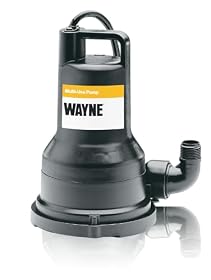 WAYNE VIP30-1/3 HP Reinforced Thermoplastic Submersible Multi-Use Pump - Up to 2,500 Gallons Per Hour…Wayne
$99.90 as of
View on Amazon
Product prices and availability are accurate as of the date/time indicated and are subject to change. Any price and availability information displayed on Amazon.com at the time of purchase will apply to the purchase of this product.
Size by lift and required flow
The pump curve shows the expected flow at different heads, usually expressed in feet. To estimate your system’s head:
- Measure the vertical distance from the pump’s operating water level to the point where the discharge line releases water outside.
- Account for resistance from the discharge pipe, elbows, and check valve. Pipe layout affects how hard the pump must work, so the vertical measurement alone is not the whole picture.
- Find the pump’s flow rate on its curve at the resulting head. Do not rely only on a maximum-flow figure, which is typically stated at a low or zero head.
- Confirm that the flow is suitable for the water entering your basin. If the basin refills rapidly during heavy rain, note how quickly the pump runs and how quickly water returns after it stops. Persistent high inflow may require a drainage assessment, not just a larger pump.
If you cannot estimate the system head or inflow confidently, ask the pump manufacturer, installer, or a qualified plumber to help match the pump to the setup.
Consider backup protection for a basement sump system
 The Basement Watchdog Combo Preassembled Primary & Battery Backup Sump Pump System w/Monitoring Controller (CITS-50);…BASEMENT WATCHDOG
$469.00 as of
View on Amazon Wayne Preassembled Primary & Battery Backup Sump Pump Combo SystemWayne
$560.41 as of
View on Amazon VEVOR 2500W Sump Pump Battery Backup System, LCD Display, Auto Switches to Battery Inverter Power…VEVOR
$185.12 as of
View on Amazon
Product prices and availability are accurate as of the date/time indicated and are subject to change. Any price and availability information displayed on Amazon.com at the time of purchase will apply to the purchase of this product.
When to consider more horsepower
Consider a higher-capacity pump when the pump curve shows that a smaller model cannot deliver enough flow at your actual head, or when a professional has confirmed that your basement has unusually heavy inflow. A 1/2-hp pump is one common step up from a 1/3-hp model, but compare the rated flow at your head before deciding.
A larger pump is not a fix for every drainage problem. If it empties the basin very quickly and the float switch then starts it again soon after, it may short-cycle. Frequent starts and stops can contribute to wear. Check that the basin, float arrangement, and pump are compatible, and follow the manufacturer’s installation guidance.
Check the rest of the system before buying
Before replacing a pump because it seems undersized, check that the existing system is set up and operating correctly:
- Make sure the float can move freely and the pump is positioned as its instructions require.
- Check for a blocked or restricted discharge line and confirm that the check valve is installed in the correct direction.
- Look for leaks or water returning to the basin through the discharge pipe after the pump stops.
- Confirm that the pump’s flow curve supports the actual lift and discharge arrangement.
- Observe whether the pump runs continuously, cycles unusually often, or fails to keep up during high inflow. Do not let a pump run dry.
A replacement pump makes sense if the existing unit has failed or its rated capacity at your system’s head is inadequate. If a correctly sized, working pump still cannot keep up, investigate the inflow and drainage system rather than continuing to increase horsepower.
Use the electrical rating and instructions too
A higher-horsepower pump may have different electrical requirements. Check the pump’s nameplate and installation manual for voltage, current, circuit, and connection requirements. Do not modify household wiring or use an extension cord as a permanent connection. If the required electrical setup is unclear, consult a qualified electrician.
FAQ
Is a 1/3-hp sump pump enough for a basement?
It is a common starting point for many residential basements, but whether it is enough depends on the water inflow, discharge lift, and pipe layout. Check the pump’s flow curve at your system’s head.
Should I choose a 1/2-hp sump pump instead?
Choose one if its flow at your actual head better matches the system’s needs. More horsepower by itself does not guarantee better performance, and an oversized pump may cycle too frequently in some setups.
Does horsepower tell me how many gallons per hour a pump moves?
No. Horsepower is the motor’s power rating. Use the manufacturer’s pump curve to find the expected flow at the lift and discharge conditions in your installation.
What if my sump pump runs constantly during rain?
Check for a freely moving float, an unobstructed discharge line, and water returning through the discharge after the pump stops. If the pump is working correctly but inflow still exceeds its capacity, investigate the drainage problem or ask a professional to assess it.