A sump pump’s GPH rating is a flow rate under stated test conditions—not a promise that it will move that much water in your basement. The pump’s performance at your actual discharge height is the number to compare.
What GPH means
GPH means gallons per hour: the volume of water a pump can move in an hour under a specific set of conditions. To convert GPH to gallons per minute (GPM), divide by 60. For example, 1,000 GPH equals about 16.7 GPM.
The important detail is that a GPH number is not meaningful on its own. It depends on the pump’s operating conditions, especially how high and how far it must move water.
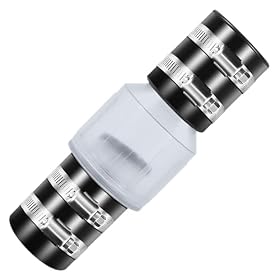
Replace a discharge check valve that restricts or allows backflow
Product prices and availability are accurate as of the date/time indicated and are subject to change. Any price and availability information displayed on Amazon.com at the time of purchase will apply to the purchase of this product.
Why the advertised number can be misleading
A pump listing may show its maximum flow at little or no lift. That figure describes an easier job than pumping water up to a discharge outlet. As the water has to rise higher, the pump generally delivers less flow.
Pipe resistance also matters. Long runs, narrow pipe, bends, and fittings can reduce flow. The combined effect of elevation and resistance is often described as total dynamic head. Use the manufacturer’s performance chart or curve to find the pump’s GPH at the head closest to your installation—not just the largest number on the box.
How to compare a rating with your setup
Find the pump’s performance chart. Look for flow at different head heights. If the manufacturer does not provide one, ask for the pump’s capacity at your expected head before relying on its maximum GPH rating.
Estimate the vertical lift. Measure the rise from the water level in the sump basin to the point where the discharge line exits or releases water. Follow the manufacturer’s guidance for how to measure head.
Account for the piping. Pipe diameter, length, elbows, and other fittings add resistance. A long or restrictive discharge route can make actual flow lower than a simple vertical-height estimate suggests.
Compare pumps at the same head. A pump with a higher maximum GPH may deliver less than another pump at the head your system requires. Compare the chart values at your operating point.
Check the rest of the system. Confirm that the discharge pipe and check valve are compatible with the pump and installed as directed. A restriction or installation problem can limit flow even when the pump itself is correctly sized.
What GPH does—and does not—tell you
GPH is a measure of flow capacity, not the amount of water your sump basin holds, how often the pump will run, or how well it handles every storm. The water entering the basin, the basin’s size, the discharge route, and the pump’s performance at operating head all affect how the system behaves.
A higher GPH rating is not automatically the better choice. Choose a pump that can handle the expected inflow at your actual head and is suitable for the basin and electrical setup. Follow the manufacturer’s sizing and installation instructions; consult a qualified professional if you are unsure about the discharge design or electrical work.
When the GPH number is not the problem
If a pump is moving much less water than its performance chart suggests, check for a clogged or restricted intake, a blocked or kinked discharge line, a stuck or incorrectly installed check valve, or a water level that is not activating the float correctly. Disconnect power before inspecting the pump or piping, and never run a pump dry. If the line is clear and the installation matches the instructions but performance remains poor, the pump may be worn or damaged and may need service or replacement.
FAQ
Is a sump pump’s maximum GPH its actual flow rate?
Not necessarily. Maximum GPH is often listed at little or no lift. Flow usually decreases as the pump works against greater head and pipe resistance. Check the manufacturer’s performance chart for flow at your installation’s head.
How do I convert GPH to GPM?
Divide GPH by 60. For example, 1,000 GPH is about 16.7 GPM.
Does a higher GPH rating mean a better sump pump?
Not by itself. Compare each pump’s flow at the head your system requires, and make sure the pump is appropriate for your basin, discharge piping, and expected inflow.
Does horizontal discharge pipe affect sump pump flow?
Yes. Pipe length, diameter, bends, and fittings create resistance, which can reduce flow. Consider the complete discharge route and use the manufacturer’s guidance when estimating system performance.