A useful sump pump review helps you decide whether a pump can move water from your basin to your discharge point, fit your setup, and keep working when needed. Look beyond the star rating: check the test conditions, flow at the lift height you need, switch design, and what the reviewer actually knows about long-term reliability.
Reviews · Mon Sep 14
How to read a sump pump review
A useful sump pump review explains how the pump performs under realistic conditions—not just its star rating or maximum gallons-per-hour figure.
Check what the review measured
Start by asking whether the review reports measured performance or repeats the manufacturer’s specifications. A review is more useful when it explains its test setup, including the vertical lift, pipe size, and discharge arrangement.
A pump’s gallons-per-hour (GPH) rating can be misleading if the review does not say what head height the figure applies to. Flow generally decreases as the pump lifts water higher. Compare performance at a lift close to your installation—not just a maximum figure that may apply at little or no lift.
The required lift is the vertical distance from the pump’s water level to the point where the discharge pipe releases water. Pipe length, elbows, and other restrictions can also affect performance. If a review offers no performance curve or test conditions, treat its flow claims as a starting point, not a guarantee for your home.
Horsepower alone is not a reliable way to compare pumps. Prefer stated flow at a relevant head height and clear information about the pump’s intended use.
Compare primary sump pumps
 AQUASTRONG 1 HP Sump Pump 4500 GPH Submersible Water Pump for Water RemovalAQUASTRONG
$65.99 as of
View on Amazon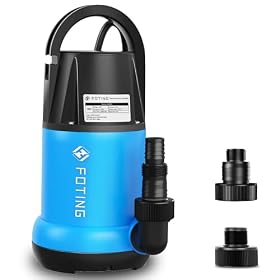 FOTING 1HP Sump Pump 4600GPH Clean/Dirty Submersible Water PumpFOTING
$59.39 as of
View on Amazon WAYNE CDU790 1/3 HP Submersible Water Pump, Heavy Duty Basement Sump PumpWayne
$137.08 as of
View on Amazon
Product prices and availability are accurate as of the date/time indicated and are subject to change. Any price and availability information displayed on Amazon.com at the time of purchase will apply to the purchase of this product.
Look for details that affect installation
A review should make clear how the pump turns on and off. Float-switch design and movement matter because a switch that catches on the basin wall or nearby pipe may not operate properly. Look for discussion of basin size, required clearance, and whether the float can move freely.
Also check details such as the outlet connection, power-cord arrangement, and whether the pump is intended for your type of installation. These are fit questions, not minor extras: a pump that cannot sit level or cycle freely may be a poor choice even if its advertised capacity looks adequate.
Treat claims about quietness, ease of setup, or build quality as more useful when the review explains how those observations were made. A single person’s impression can be informative, but it may not transfer to every basement or installation.
Consider backup protection
 The Basement Watchdog Combo Preassembled Primary & Battery Backup Sump Pump System w/Monitoring Controller (CITS-50);…BASEMENT WATCHDOG
$469.00 as of
View on Amazon Wayne Preassembled Primary & Battery Backup Sump Pump Combo SystemWayne
$549.99 as of
View on Amazon VEVOR 2500W Sump Pump Battery Backup System, LCD Display, Auto Switches to Battery Inverter Power…VEVOR
$185.12 as of
View on Amazon
Product prices and availability are accurate as of the date/time indicated and are subject to change. Any price and availability information displayed on Amazon.com at the time of purchase will apply to the purchase of this product.
Separate reliability evidence from ratings
Star ratings summarize opinions; they do not show how a pump performs during a power outage, heavy inflow, or years of cycling. Read written reviews for specific, repeated issues, such as a switch failing to activate, leaks, or trouble fitting a common basin. Give more weight to detailed accounts than to vague praise or complaints.
Be cautious about using a short-term review to predict service life. Long-term ownership reports can add context, but they still reflect one household’s water conditions, installation, and maintenance. A review that clearly distinguishes observed facts from expectations is easier to trust.
Check when the review was published and whether it concerns the same version of the product you are considering. Product details and included parts can change; make sure the current manufacturer information matches what the review describes.
Use reviews to make a short list
Before deciding, compare reviews against your own setup:
- Estimate the vertical lift and note the pipe route and outlet size.
- Confirm that the pump fits the basin and that its float can move freely.
- Compare flow at a relevant head height, if the information is available.
- Check the manufacturer’s current specifications, installation instructions, and warranty terms.
- Decide whether you need a battery or water-powered backup for your situation; a primary pump review does not establish backup capability.
If reviews do not provide enough information to judge capacity or fit, look up the manufacturer’s documentation or contact the manufacturer before buying. For a new installation or uncertain electrical setup, follow the instructions and consult a qualified professional as appropriate.
FAQ
Is a higher GPH rating always better?
No. GPH depends on the lift height and test conditions. Compare flow at a head height similar to your installation, and confirm the pump fits and cycles properly in your basin.
How much should I trust sump pump star ratings?
Use ratings as a quick summary, not proof of capacity or long-term reliability. Read detailed reviews for specific, repeated problems and verify specifications with the manufacturer.
What is the most important specification in a sump pump review?
For capacity, look for flow at a stated head height. Also check fit-related details such as basin clearance, float movement, and outlet compatibility.